









Church Prayer Chain and Prayer Line: How to Set One Up
Set up a church prayer chain and request line, print a request card, and copy email and text wording with private sharing choices.
What changed on October 23, 2026: Added request forms and message wording, church-owned phone guidance, civil reporting duties and incident-record preservation.
Short answer
A prayer chain is a list of church members who agree to pray for every request passed to them, by text, email or phone. A prayer line is the number or form where anyone can ask the church to pray. Set up both with one coordinator, a request card, a rule that the person asking decides who reads it, and a message that goes out the same day.
- When a request should reach the prayer chain
- Same day
- The default for any request until the person says otherwise
- Pastors only
- Call or text for a mental health or suicide crisis
- 988
On this page
A church prayer chain is a list of members who agree to pray for every request passed to them, and a prayer line is the phone number or form where anyone can ask the church to pray. This guide shows how to set up both: who runs them, the card and the form, the exact wording for the emails and texts, and the rules that keep a private request private.
Primary sources and professional review
Source check: October 23, 2026. The Child Welfare Information Gateway overview covers laws through May 2023. Confirm the current statute and reporting duty for each role in the church’s state. Reports to civil authorities and preservation of incident records take priority over routine prayer-list cleanup.
If you need prayer right now
Call a church near you during office hours and ask for a pastor to pray with you. The church finder lists churches by city with their phone numbers.
The Billy Graham Evangelistic Association runs a prayer line that takes requests at any hour.
Call 911 if someone is in danger now. If you are thinking about suicide or are in a mental health crisis, call or text 988 to reach the 988 Suicide and Crisis Lifeline.
Choose one prayer coordinator
Give one person the job of receiving every request and sending it out. A church that lets requests flow from anyone to everyone loses track of who asked for what, shares things it should not, and forgets to send the update when the surgery goes well. The coordinator can be a staff member or a volunteer, and needs a phone they check every day and a pastor they can call.
Name a back-up for the weeks the coordinator travels, and write the coordinator’s name and number in the bulletin and on the website.
Set up the prayer chain
The chain is the list of people who pray. Ask for volunteers from the pulpit and in the bulletin. Each volunteer agrees to pray for requests the day they arrive and keep them within the chain, without forwarding messages outside it.
Send requests by group text or email according to what members use. For people who do not text, set up a phone tree where each person calls the next two. Ask the chain not to reply to the group, so the only messages on it are requests and updates.
Clean the list each January. Ask everyone on it whether they want to stay, and remove anyone who does not answer.
Set up the prayer line
The prayer line is how requests reach the coordinator. Give people three ways in, and send all three to the same person.
- Use a church-owned phone number with voicemail and a named backup. Check that the phone service permits organizational use, supports the messages you plan to send, and lets the church keep the number when a volunteer leaves.
- A form on the church website. Ask for the request, a name, a phone or email, and who may read it, and send each form to the coordinator’s email.
- A card in the pews. Print the card below, set a stack in each pew rack, and ask people to drop it in the offering plate or hand it to a pastor.
Promise a reply within a day, and have the coordinator answer every request, even with one line.
The prayer request card
The card asks for the request, a name, a way to reach the person, and who may read it. The default is pastors only, printed on the card, so nobody shares a request the person meant for the pastor’s ears.
Who may read it? ☐ Pastors only ☐ Pastors and the prayer team ☐ The prayer list in the bulletin, first name only ☐ Please call me If nothing is checked, only the pastors read it.
The wording for texts and emails
Use the same four messages every time, so the chain knows what each one means.
When a request comes in by phone or in the hallway, ask first:
Thank you for telling me, Linda. May I share this with the prayer team, or would you like it to stay with the pastors?
To the prayer chain by text, under 160 characters so it arrives as one message:
Prayer request: Tom has heart surgery Thursday morning. Please pray for his doctors and his wife, Ann. Keep this within the prayer team.
To the prayer chain by email:
Dear prayer team,
Tom asked us to pray for him this week. He has heart surgery on Thursday morning at 7, and he asked us to pray for his surgeon, his recovery and his wife, Ann, who will be at the hospital all day.
Tom has agreed to share this with the prayer team. Please keep it within the team.
I will send an update when I hear from Ann.
When there is news:
Update on Tom: his surgery went well, and he is in recovery. Ann thanks everyone for praying. Please keep praying for his healing this week.
Private requests
Four rules keep a request from going further than the person who asked wanted it to go.
- The person asking decides who reads it. Pastors only, the prayer team, or the printed list. When you are not sure, ask, and keep it with the pastors until you hear back.
- If Tom agreed to share a request for his surgery, send only that request. Keep a diagnosis, a test result or the name of a hospital out unless he agreed to share those details too.
- A request about someone else waits for that person’s consent. If a daughter asks for prayer about her father’s drinking, pray for a family member without naming him or sharing details until he consents.
- Follow a written retention schedule for ordinary requests. Preserve reports of abuse, threats, injuries and any records subject to a legal hold. Keep those records in the restricted incident file, with access approved by the church’s attorney.
Call 911 for immediate danger and keep the request off the prayer chain. The coordinator also keeps requests about child abuse or suicide off the chain and follows the reporting law in the church’s state. Check any duty the coordinator personally has to report suspected child abuse to the designated civil authority. An internal report to a pastor does not replace a required civil report. Preserve the original request and tell the safeguarding lead without delaying the report.
Requests from children stay with a pastor and one other adult on staff, and never go to the prayer team or the printed list.
The prayer list in the bulletin
A printed list reaches members who are not on the chain. Print first names and the need, and only for people who checked that box on the card or said yes when asked. Take each name off after four weeks unless the person asks to stay on, so the list stays current and nobody wonders why a name has been there since spring.
An app for prayer requests
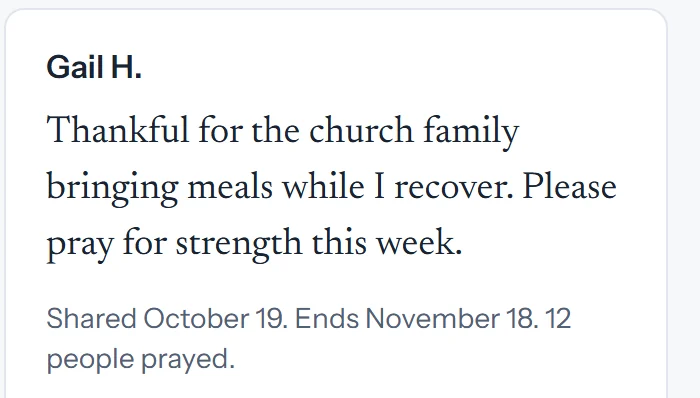
cOS Prayer Requests is a free app from Covenant OS for prayer requests and a church prayer wall. The person asking chooses who reads a request: the pastors, the prayer team or the church’s prayer wall. Every request starts with the pastors only, and the coordinator approves it before it reaches the team or the wall. A request that names someone else waits for that person’s consent. A child’s request stays with a pastor and another adult on staff.
Free app from Church Posting
cOS Prayer Requests
Take requests by phone, form and card, and send each one only as far as the person asking chose.
See cOS Prayer RequestsFor texting the prayer chain, cOS Texting sends group texts from your church’s own number.
Questions people ask
How does a church prayer chain work?
A member or a guest gives a request to the prayer coordinator by card, phone, text or form. The coordinator checks who the person wants to read it, writes it in two or three sentences, and sends it to everyone on the chain the same day. Each person prays, and the coordinator sends an update when there is news.
What should a prayer request card ask for?
The request, a name, a phone number or email, and who may read it: pastors only, the pastors and the prayer team, or the printed prayer list. Add a box for 'Please call me.' If nothing is checked, only the pastors read it.
How do you keep prayer requests private?
Let the person asking decide who reads the request, share only what they agreed to, and never pass on a request about someone else without that person's consent. Send requests to a closed list, never a public page, and follow a written retention schedule and preserve reports of abuse, threats and other incidents.
How do I start a prayer line at my church?
Pick a coordinator, get a phone number that forwards calls and texts to that person, and put a prayer request form on the church website that emails the same person. Publish the number and the form in the bulletin and on the website, and promise a reply within a day.
What do I do if a prayer request reveals abuse or danger?
Do not forward it to the prayer chain. Call 911 for immediate danger. Follow your state's reporting law and report suspected child abuse to the designated civil authority when required. Notify the church's safeguarding lead without delaying that report.
Sources
- Clergy as Mandatory Reporters of Child Abuse and Neglect, Child Welfare Information Gateway, U.S. Department of Health and Human Services. Read October 23, 2026.
- 988 Suicide and Crisis Lifeline, 988 Suicide and Crisis Lifeline. Read October 23, 2026.
- Billy Graham 24/7 Prayer Line Request, Billy Graham Evangelistic Association. Read October 23, 2026.
- cOS Prayer Requests, Covenant OS. Read October 23, 2026.
More on communications
All communications articlesChurch texting services, with Text In Church pricing
Compare church texting services, check consent and opt-out rules, and plan who will answer replies from your congregation.
Church Social Media Policy: Full Text and Photo Rules
A church social media policy your board can review and adopt, with photo consent, account access and volunteer offboarding rules.
Church Social Media Calendar: Twelve Months of Post Ideas
Download a church social media calendar as CSV or ICS, with church year dates and a posting routine for volunteers.
The weekly email
New free tools, guides and jobs, in one email on Sundays.