


Win Them Before 18, Form Them Before 30: Family Discipleship and Young Adult Ministry
Two in three born-again adults came to faith before 18, most often led by their parents. From 18 to 30 a young adult has the time to be trained hard. How a church should plan discipleship around both windows.
Short answer
Two in three born-again American adults came to faith before 18, and parents lead more children to Christ than anyone else, so a church's first work with children is training mothers and fathers, above all fathers, to disciple them at home. From 18 to 30 a young adult has more free hours and fewer obligations than they will have again for decades, so the church should ask far more of them: weekly training under a strong teacher, a mentor, and a standard they can fail.
- Of born-again adults in Barna's 2004 study who came to Christ before 18
- 64%
- SBC baptisms per child against per adult over 30, by population, 2025
- 24 to 1
- Between a man's 18th birthday and his median first wedding, 2025
- 12.8 years
On this page
- Two in three came to faith before 18
- Parents lead more children to Christ than anyone else
- The father’s faith carries the most weight
- What a church does in the first window
- Church attendance from 17 to 19
- The second window has doubled since 1975
- Ask more of a 22-year-old than of a 35-year-old
- Train young men in true masculinity
- Train young women in true femininity
- Stop sending every interested 20-year-old to Bible college
- The two windows make one loop
- Questions people ask
My pastor, Willy Rice, preached Ecclesiastes 12 at Calvary Church in Clearwater. The chapter opens with a command to the young: “Remember your Creator in the days of your youth, before the days of adversity come” (Ecclesiastes 12:1). In that sermon he said this:
Because most people who come to Christ come to Christ before they’re 18. Now I’m grateful for everybody who comes to Christ after 18… If somebody gets saved at 60, you know what they say? I wish I’d gotten saved at 16. If somebody meets Jesus at 80 and they really meet him, you know what they’ll say? I wish I’d met him when I was eight.
Then he told the church, “You have got to prioritize reaching and training the next generation.”
He is right, and I want to push his point further. A church should build its whole discipleship plan around two windows of life. The first runs from birth to 18, when most people come to Christ and when their parents shape them more than anyone else alive, fathers above all. The church cannot win that window alone, so it has to train parents to disciple their own kids. The second runs from 18 to 30, the years after a person leaves home and before marriage, children and a heavy job fill every evening. In those years a strong teacher and a mentor can form a young adult hard, and most churches waste them.
Two in three came to faith before 18
The best-documented figure comes from Barna Group. In 2004 Barna surveyed 992 American adults who said they had made a personal commitment to Jesus Christ that was still important in their life. Forty-three percent made that commitment before they turned 13. Another 21% made it between 13 and 17, so 64% came to Christ before their 18th birthday. Thirteen percent came between 18 and 21, and 23% came at 22 or older.
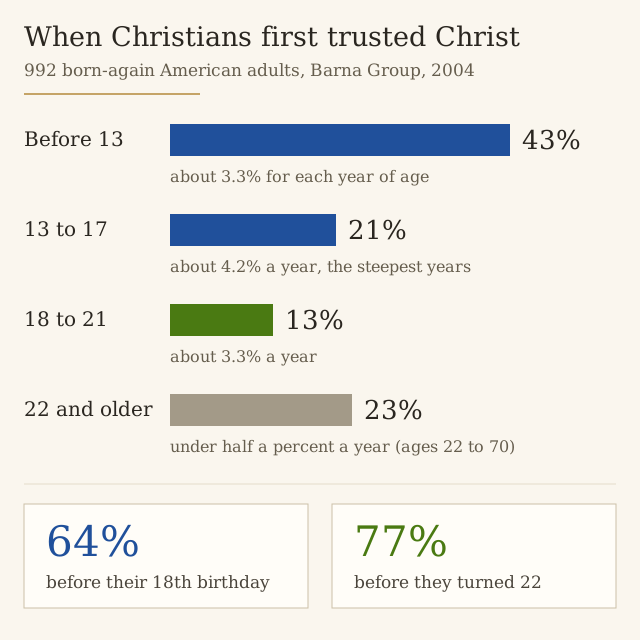
Barna counted only adults whose faith had lasted. So this is the age when lasting faith began, and for two in three it began in childhood.
Southern Baptist baptism counts say the same thing. In 2025, Southern Baptist churches baptized 263,075 people, the most since 2016. Adults 30 and older made up 33% of them and young adults 18 to 29 another 20%, so more than half were 18 or older. In 1971 children and youth made up 68%, so the window looks like it is closing until you divide by the population of each age group. Southern Baptist churches baptized 5.66 of every 1,000 American children 11 and under, 2.32 of every 1,000 youth, 1.19 of every 1,000 young adults and 0.24 of every 1,000 adults 30 and older. A child was about 24 times as likely to be baptized as an adult over 30, and adults add up to more baptisms because there are far more of them.
Pew Research Center’s 2023-24 Religious Landscape Study counts the losses. About 3.6% of American adults have become Christians and 21.9% have left Christianity, which means six people walked out for every one who came in.
Pastor Willy put the reason plainly: “The human heart gets harder and harder and harder. And the more you say no to God, the less likely it is you’ll ever say yes to God.”
Parents lead more children to Christ than anyone else
Barna asked the same 992 adults who led them to Christ. Among those who came before 13, half were led by their parents and another one in five by a friend or relative, while 7% came through a minister’s personal prompting. Among adult converts, parents accounted for 8% and ministers for about one in ten.
Parents led seven times as many of those children to Christ as ministers did, and that is the order God set in the law:
These words I am commanding you today are to be upon your hearts. And you shall teach them diligently to your children and speak of them when you sit at home and when you walk along the road, when you lie down and when you get up. (Deuteronomy 6:6-7)
A church gets a child for about an hour a week, and the parents get the breakfasts, the car rides, the dinner table and bedtime.
The father’s faith carries the most weight
Sociologists who study how faith passes from parent to child keep landing on the home. Christian Smith and Amy Adamczyk, writing from the National Study of Youth and Religion, put it in one line: “Parents set a ‘glass ceiling’ of religious commitment above which their children rarely rise.” They go on: “for intergenerational religious transmission today, the key agents are parents, not clergy or other religious professionals.”
Inside the home, the father carries the most weight. Vern Bengtson followed four generations of California families and published the results as Families and Faith in 2013. A 2014 review in Sociology of Religion quotes his conclusion that “a close bond with a father has more of an impact on religious perpetuity than a relationship with a mother.” A 2024 University of Delaware dissertation using the national Add Health data found the quality of a father’s relationship with his child predicted the child’s religiousness in adolescence and again in early adulthood, while the mother’s relationship predicted it in adolescence only.
The starkest numbers come from Switzerland. In the Swiss Family Survey of 1994 and 1995, adults reported their own church practice and their parents’ practice, and Werner Haug and Philippe Wanner of the Swiss Federal Statistical Office published the table in 1998. Where both parents attended regularly, 32.8% of the children grew up to attend regularly. The share rose to 44.2% when the father attended and the mother did not practice at all, higher than with both parents in the pew, and it fell to 1.5% when the mother attended and the father did not practice.
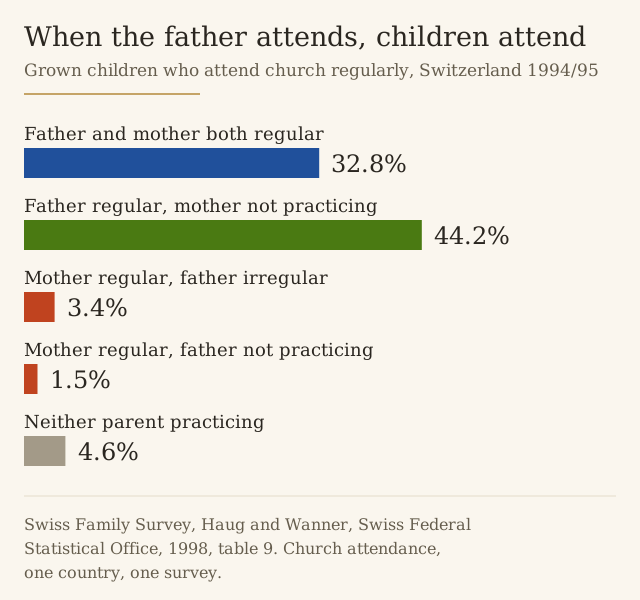
Robbie Low brought the table to English readers in Touchstone in 2003, and his numbers match the original.
Most fathers have handed the spiritual work to their wives. Barna’s 2018 Households of Faith study asked 448 Christian teenagers who they turn to. Mothers led on the spiritual measures Barna reported: 63% named mom as their main partner in prayer, 70% in conversations about God and 71% in conversations about the Bible. Fathers showed up for money (74%) and logistical help (63%). Their daughters feel the gap as they grow up. In Barna’s 2023 survey of Americans aged 13 to 24, 47% of teen girls said they felt supported by their father, and 23% of women 18 to 24 did.
Paul addresses the command to fathers by name: “Fathers, do not provoke your children to wrath; instead, bring them up in the discipline and instruction of the Lord” (Ephesians 6:4), so a church that wants children who follow Christ has to train fathers to lead them.
What a church does in the first window
Pastors already know the home comes first. In a 2018 Barna survey with Cardus, 99% of Protestant pastors ranked parents first among those responsible for a child’s spiritual formation, yet about 20% said they prioritize training parents and 73% said they handle children’s formation mainly through Sunday school and youth classes. When Lifeway surveyed 1,200 parents of children under 18, 83% said parents should be most responsible for a child’s spiritual development, and 14% said they were very familiar with what the Bible says about parenting. Parents know the job is theirs, and few of them know what the Bible tells them to do with it.
So the church’s main work in the first window is training parents, with children’s ministry backing up the home. A church of 70 or of 2,000 can start with these five.
- Teach parents what to do at the table. Give every family a short weekly plan tied to Sunday’s text: one passage, three questions, one prayer. Ten minutes at dinner five nights a week gives a child almost an hour of Scripture at home.
- Meet with the fathers every month. Ask each man by name whether he led his family in the Word that week, and train the men to read Scripture aloud, pray with their wives and children, and answer hard questions.
- Equip parents at the turning points. Hold short classes when a child is born, starts school, turns 12 and turns 16, the moments when parents ask for help.
- Put five adults around every teenager. In Lifeway’s 2007 study, 46% of young adults who stayed in church said five or more adults at church had invested in them personally and spiritually, against 28% of those who dropped out. Assign every teenager five adults who know their name.
- Cover the children without fathers. Single mothers, children of unbelievers and kids who come on the church bus need a man from the church who will stand in, and the elders should assign one and hold him to it.
Church attendance from 17 to 19
Attendance falls off a cliff as the first window closes. In 2017 Lifeway Research surveyed 2,002 Americans aged 23 to 30 who had attended a Protestant church at least twice a month for at least a year of high school. Regular attendance fell from 69% at 17 to 58% at 18 and 40% at 19, and two-thirds stopped attending for a year or more between 18 and 22.
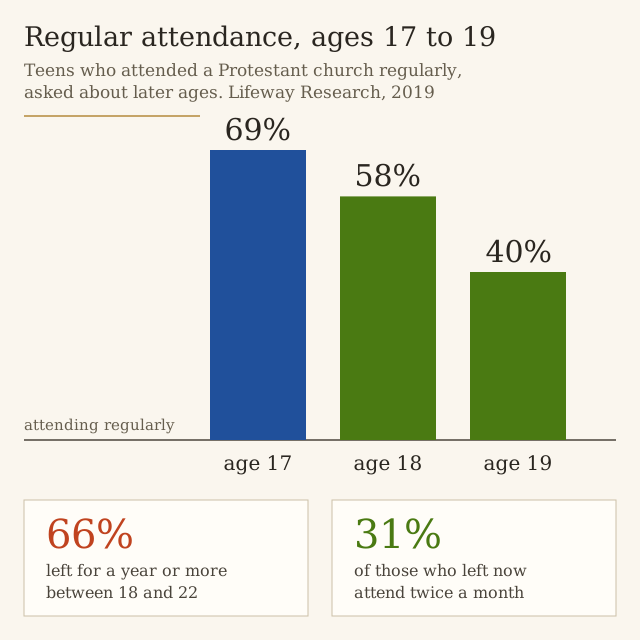
The top reason they gave was moving to college and no longer attending, at 34%. Next came church members seeming judgmental or hypocritical (32%), no longer feeling connected to people at church (29%), disagreement over political or social issues (25%) and work (24%). Most of that list describes a church with nothing to ask of an 18-year-old. Lifeway found 31% of those who left had come back to attending twice a month or more, and the rest are still gone.
The second window has doubled since 1975
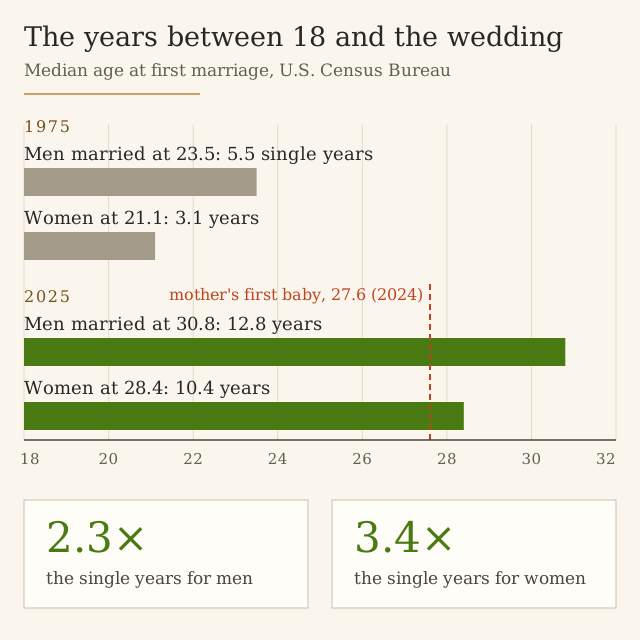
In 1975 the median American man married at 23.5 and the median woman at 21.1. In 2025 the Census Bureau put those ages at 30.8 and 28.4. A young man now has 12.8 years between his 18th birthday and his wedding, more than twice what he had in 1975, and a young woman has 10.4, more than three times as many. The average American mother had her first child at 27.6 in 2024.
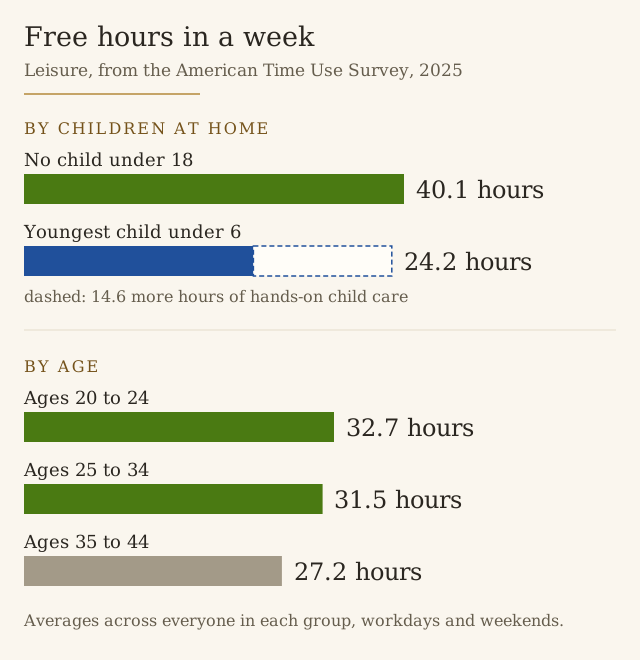
Those years also hold more free time than the years of raising children. The Bureau of Labor Statistics American Time Use Survey for 2025 found adults aged 20 to 24 averaging 32.7 hours of leisure a week, against 27.2 for adults 35 to 44. Adults whose youngest child is under 6 averaged 24.2 hours of leisure, and spent another 14.6 hours a week caring for their children hands-on. Workers aged 20 to 24 averaged 34.2 hours on the job a week, against 39.9 for workers 25 to 54, and 38.4% of employed 18- to 24-year-olds usually work part time.
Paul saw the same thing two thousand years ago: “The unmarried man is concerned about the work of the Lord, how he can please the Lord. But the married man is concerned about the affairs of this world, how he can please his wife, and his interests are divided” (1 Corinthians 7:32-34).
Ask more of a 22-year-old than of a 35-year-old
I once ran a young adults group that started as a game night and turned into a Bible study. I could tell a young man there: you need to be here today, and today, and today, and another day, and you will commit hours to this. He worked 25 hours a week and had no wife or kids, and because I knew his life I could hold him to it. That is a different conversation from the one I would have with a 35-year-old father of four, if I asked him to come Wednesday night, Thursday night and Saturday morning and then serve on Sunday.
I remember a conversation with my dad about this. Most churches I know ask the same thing of both men: come Sunday, join a small group, maybe serve once a month. That asks too much of the father of four and far too little of the 22-year-old. Men and women his age average about 32 hours of leisure a week, and if the church does not claim those hours, his phone, his job and his friends will.
So ask him for more, through a second-window program with five parts.
- A cohort that meets every week for 12 to 18 months. It runs on a schedule with a reading load, assignments and attendance, and it ends in a commissioning in front of the church.
- A strong, trained teacher. In a church of 70 that may be the pastor, and in a church of 4,000 an elder or a staff pastor. He knows the Bible, holds sound doctrine and can lead young men. Never hand the group to a weak, untrained man because he was the one who volunteered.
- A mentor, and define the word. Most of what churches call mentoring is an older man who buys a young man coffee, listens for an hour and tells him he is doing fine, and that forms nobody. In this program a mentor is an older man for the young men, or an older woman for the young women. The mentor sets the reading, checks the work, calls the day someone misses, says the hard thing to their face and stays on it for the full 12 to 18 months.
- Hours of real work. Put them to work teaching children, setting up rooms, visiting the sick and leading a table of high schoolers, and give them jobs that fail if they do not show up.
- A standard they can fail. Set an attendance rule, such as three missed weeks and you wait for the next cohort. A rule like that tells a 22-year-old the church takes him seriously, however harsh it sounds in churches built to keep everyone comfortable.
“It is good for a man to bear the yoke while he is still young” (Lamentations 3:27).
Train young men in true masculinity
Young men are now in church as often as young women. In its 2026 summary Public Religion Research Institute wrote that “young women’s declining religiosity has brought them on par with their male counterparts for the first time.” PRRI found weekly attendance among men 18 to 29 at 16% in 2016 and 18% in 2024, while among women the same age it fell from 29% to 19%.
The young men who come are asking the church for weight. In Barna’s October 2025 survey of 3,049 Americans aged 18 to 35, men in both age groups were more likely than women to say they attend church to confess their sins and to experience the liturgy and the church calendar.
A church that tries to reach young men with barbecues, trucks and a men’s breakfast dresses them in a costume. Scripture defines a man by the work God hands him. God put the first man in the garden “to cultivate and keep it” (Genesis 2:15), so a man works, guards what is given to him and answers to God for it. Paul’s charge to the men at Corinth reads like orders: “Be on the alert. Stand firm in the faith. Be men of courage. Be strong” (1 Corinthians 16:13). John wrote to young men as fighters: “I have written to you, young men, because you are strong, and the word of God abides in you, and you have overcome the evil one” (1 John 2:14), and Paul told Titus to “urge the younger men to be self-controlled” (Titus 2:6).
Train young men to lead a home, protect it and provide for it, and to stay faithful to one woman for life. Give them a hill to climb: a reading plan they will struggle to finish, a fast, a 6 a.m. prayer meeting, and an older man who pushes them harder than anyone ever has and does not accept excuses.
Train young women in true femininity
Young women are leaving faster than young men. PRRI found 40% of women 18 to 29 unaffiliated with any religion in 2024, up from 29% in 2013, while men the same age held at 35 to 36%. In Barna’s 2023 survey, 36% of women 18 to 24 felt supported by their mother, against 74% of teen girls.
They still come for worship. In Barna’s 2025 survey, 45% of women 18 to 24 said they attend church to worship alongside other people, against 31% of men that age. Too many churches answer them with emotional music, dim lights and a women’s night of candles and coffee, and call it discipleship. Scripture describes a woman of weight: “Strength and honor are her clothing, and she can laugh at the days to come” (Proverbs 31:25). Peter puts her beauty in “the unfading beauty of a gentle and quiet spirit, which is precious in God’s sight” (1 Peter 3:4).
Young women need the same Bible and the same doctrine the men get, and they need older women who will teach them to live as women. Paul gave that job to the older women of the church: “Older women, likewise, are to be reverent in their behavior, not slanderers or addicted to much wine, but teachers of good. In this way they can train the young women to love their husbands and children, to be self-controlled, pure, managers of their households, kind, and submissive to their own husbands, so that the word of God will not be discredited” (Titus 2:3-5). Pair every young woman in the cohort with an older woman who has lived it, and give her theology she can stand on when feelings fade.
Stop sending every interested 20-year-old to Bible college
When an 18- to 22-year-old shows a little interest in the Bible, many churches tell them to go to Bible college. Most of them do not need to go. A church that sends them off at the first sign of hunger hands its own job to a school and gives away the years it could have spent training them.
Churches do not require the degree even for youth and children’s staff. In a 2008 Lifeway survey of Protestant pastors, reported by The Christian Post, 10% required a seminary degree of candidates for age-group ministry. At the schools themselves, the Association of Theological Schools reports that Master of Divinity enrollment at its member schools fell 8.3% from 2021 to 2025, while students in non-degree programs rose from 3,966 to 6,200.
The local church should do 90% of what a seminary does. Most Christians will never enroll in one, and every one of them is called to know the Bible and serve the church. A young man who spends two years in a church cohort under a strong teacher, with a mentor, while working a job, learns the Bible, learns to teach it and learns to serve the church that will one day call him an elder. If he is called to seminary after that, he goes knowing why. Paul’s plan for training leaders ran through the church: “The things that you have heard me say among many witnesses, entrust these to faithful men who will be qualified to teach others as well” (2 Timothy 2:2).
The two windows make one loop
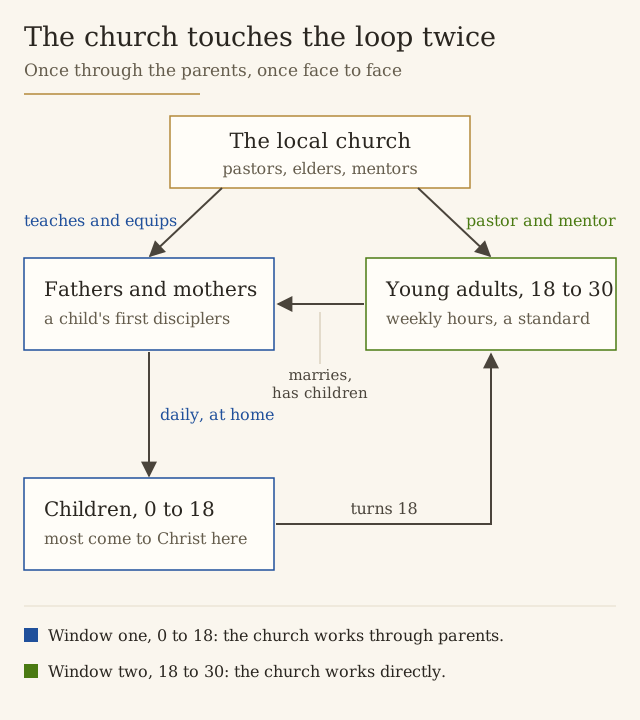
The second window feeds the first. The 24-year-old a church trains hard today is the father at the dinner table in eight years, opening the Bible with his own children. A church that skips those years will spend the next generation begging fathers to do what nobody trained them to do.
Psalm 78 describes the whole loop: “We will not hide them from their children but will declare to the next generation the praises of the LORD… that the coming generation would know them, even children yet to be born, to arise and tell their own children” (Psalm 78:4, 6).
The verses on this page are from the Berean Standard Bible, which its publisher dedicated to the public domain as of April 30, 2023.
Questions people ask
At what age do most people become Christians?
Before 18. In Barna's 2004 survey of 992 born-again American adults, 43% came to Christ before 13 and 64% before 18. Southern Baptist churches baptized 5.66 children per 1,000 American children in 2025, against 0.24 per 1,000 adults 30 and older.
Why should a church focus on fathers?
Because the father's faith carries the most weight. In the Swiss Family Survey of 1994 and 1995, 44.2% of children with a churchgoing father and a non-practicing mother grew up to attend regularly, against 1.5% with a churchgoing mother and a non-practicing father.
What is the 4/14 window?
A missions term, first drawn by Bryant Myers of World Vision and later spread by Luis Bush, for the years from 4 to 14, when most people come to faith. Barna's data put the window from birth to 18, with the largest share before 13.
How many young people leave church after high school?
In Lifeway Research's 2017 survey of 2,002 adults aged 23 to 30 who attended a Protestant church regularly in high school, 66% stopped attending for at least a year between 18 and 22. Of those, 31% attend twice a month or more today.
Should a young adult who wants to serve go to Bible college?
Most do not need to. A young adult who shows interest in the Bible should first be trained in their own church for a year or two by a strong teacher and a mentor while they work. Only 10% of Protestant pastors surveyed by Lifeway in 2008 required a seminary degree of candidates for age-group ministry.
Sources
- Life Under The Sun, Ecclesiastes 12 (11am service), Calvary Church, Clearwater. Read October 25, 2026.
- Evangelism Is Most Effective Among Kids, Barna Group. Read October 25, 2026.
- Adults account for most baptisms in SBC congregations, Lifeway Research. Read October 25, 2026.
- Religious Landscape Study 2023-24, Pew Research Center. Read October 25, 2026.
- Most Teenagers Drop Out of Church When They Become Young Adults, Lifeway Research. Read October 25, 2026.
- Parents, churches can help teens stay in church (Facts & Trends, November 2007), Lifeway Research. Read October 25, 2026.
- Faith of Our Mothers and Fathers (excerpt from Handing Down the Faith), Christianity Today. Read October 25, 2026.
- Review of Families and Faith: How Religion Is Passed Down across Generations, by Vern L. Bengtson, Sociology of Religion. Read October 25, 2026.
- Religious development from adolescence to early adulthood: the effects of parental religiousness and relationship quality, University of Delaware. Read October 25, 2026.
- The Powerful Influence of Moms in Christians' Households, Barna Group. Read October 25, 2026.
- Who Is Responsible for Children's Faith Formation?, Barna Group and Cardus. Read October 25, 2026.
- Lifeway Research Looks at Role of Faith in Parenting, Lifeway Research. Read October 25, 2026.
- Gen Z, Gender, and Religion, Public Religion Research Institute. Read October 25, 2026.
- New PRRI Data Rebuts Religious Revival Claims, Public Religion Research Institute. Read October 25, 2026.
- What Young Adults Are Looking for Spiritually at Church, Barna Group. Read October 25, 2026.
- Gen Z Women Struggle to Find Their Place in Christian Faith and Community, Barna Group. Read October 25, 2026.
- Historical Marital Status Tables, MS-2: Estimated Median Age at First Marriage, U.S. Census Bureau. Read October 25, 2026.
- Births and Natality, FastStats, National Center for Health Statistics. Read October 25, 2026.
- American Time Use Survey, Table 3: Time spent in primary activities by age, 2025, U.S. Bureau of Labor Statistics. Read October 25, 2026.
- American Time Use Survey, Table 8A: Time spent in primary activities by age of youngest child, 2025, U.S. Bureau of Labor Statistics. Read October 25, 2026.
- Employed and unemployed full- and part-time workers by age, Table 8, U.S. Bureau of Labor Statistics. Read October 25, 2026.
- 2025-26 Annual Data Tables, Association of Theological Schools. Read October 25, 2026.
- Pastors still value, use seminary education, The Christian Post, reporting Lifeway Research. Read October 25, 2026.
- La situation démographique des groupes linguistiques et religieux en Suisse (Démos 3/4 98), tableau 9, Werner Haug and Philippe Wanner, Swiss Federal Statistical Office. Read October 25, 2026.
- The Truth About Men & Church, Robbie Low, Touchstone. Read October 25, 2026.
- Berean Bible: Terms and Conditions, Berean Bible. Read October 25, 2026.
More on outreach
All outreach articlesChurch bylaws guide and adoption checklist
Draft church bylaws from your church's governing documents, define who decides, and follow the adoption checklist with your church's attorney.
Church membership covenant example
A church membership covenant example with promises of worship, prayer, care and service, plus adoption guidance, a printable PDF and slides.
Church security plan and Sunday safety checklist
Build a church security plan with local responders, assign Sunday responsibilities, and print a checklist for evacuation and child reunification.
The weekly email
New free tools, guides and jobs, in one email on Sundays.